Platinum



Platinum is a popular commodity that is frequently used in trading portfolios for hedging purposes. Though the metal is produced in much smaller quantities than gold and silver, it is used in a variety of global commercial and industrial sectors, leading to frequent price movements and trading opportunities that can be accessed through UK brokers.
This tutorial will explain how to start trading platinum online, with information on key price influences, major market players, and strategy tips. Our team have also reviewed and listed the top platinum brokers in 2026:
Best Platinum Brokers UK
-


Founded in Australia in 2010, Pepperstone is a highly regarded broker specialising in forex and CFDs. Serving more than 400,000 clients globally, it provides access to over 1,300 financial instruments through popular platforms like MT4, MT5, cTrader, and TradingView. Its fee structure is both low and transparent. With regulation by reputable bodies such as the FCA, ASIC, and CySEC, Pepperstone guarantees a safe trading environment for traders at every level.
Instruments Regulator Platforms CFDs, Forex, Currency Indices, Stocks, Indices, Commodities, ETFs, Crypto (only Pro clients), Spread Betting FCA, ASIC, CySEC, DFSA, CMA, BaFin, SCB MT4, MT5, cTrader, TradingView, AutoChartist, DupliTrade, Quantower Min. Deposit Min. Trade Leverage $0 0.01 Lots 1:30 (Retail), 1:500 (Pro) -
Established in Poland in 2002, XTB caters to over a million clients worldwide. This forex and CFD broker offers a robust regulatory framework, a diverse range of assets, and prioritises trader satisfaction. It provides an intuitive proprietary platform equipped with excellent tools to support aspiring traders.
Instruments Regulator Platforms CFDs on shares, Indices, ETFs, Raw Materials, Forex currencies, cryptocurrencies, Real shares, Real ETFs FCA, CySEC, KNF, DFSA, FSC xStation Min. Deposit Min. Trade Leverage $0 0.01 Lots 1:30 -
Eightcap, an acclaimed broker regulated by the FCA, offers exceptionally low trading costs. Recognised as the top-rated brand by TradingView's vast user base of 100 million, traders can directly access the platform. UK traders can open a live account with a minimum deposit of just £100.
Instruments Regulator Platforms CFDs, Forex, Stocks, Indices, Commodities ASIC, FCA, CySEC, SCB MT4, MT5, TradingView Min. Deposit Min. Trade Leverage £100 0.01 Lots 1:30 -
eToro is a leading multi-asset platform providing trading services across numerous CFDs, stocks, and cryptocurrencies. Since its 2007 inception, it has attracted millions of traders worldwide. It operates with authorisation from top regulators such as the FCA and CySEC. Its social trading feature is especially well-regarded. Crypto investments are high-risk and possibly unsuitable for retail investors. There's a potential to lose all invested capital. Familiarise yourself with the risks. 61% of retail CFD accounts incur losses.
Instruments Regulator Platforms CFDs, Forex, Stocks, Indices, ETFs, Smart Portfolios, Commodities, Futures, Crypto, NFTs FCA, ASIC, CySEC, FSA, FSRA, MFSA, CNMV, AMF eToro Web, CopyTrader, TradingCentral Min. Deposit Min. Trade Leverage $50 $10 1:30 -
Established in 2009, Vantage provides trading on more than 1,000 short-term CFD products to over 900,000 clients. Forex CFDs are available from 0.0 pips on the RAW account via TradingView, MT4, or MT5. Regulated by ASIC, Vantage ensures that client funds are kept in separate accounts. Traders looking to copy strategies will benefit from a wide array of social trading tools.
Instruments Regulator Platforms CFDs, Forex, Stocks, Indices, Commodities, ETFs, Bonds, Spread betting FCA, ASIC, FSCA, VFSC ProTrader, MT4, MT5, TradingView, DupliTrade Min. Deposit Min. Trade Leverage $50 0.01 Lots 1:30 -
Founded in 2008 and based in Israel, Plus500 is a leading brokerage with over 25 million registered traders across more than 50 countries. It focuses on CFD trading, offering a user-friendly proprietary platform and mobile app. The company provides competitive spreads and does not impose commissions or charges for deposits or withdrawals. Plus500 stands out as a highly trusted broker, licensed by respected authorities such as the FCA, ASIC, and CySEC.
Instruments Regulator Platforms CFDs on Forex, Stocks, Indices, Commodities, ETFs, Options FCA, ASIC, CySEC, DFSA, MAS, FSA, FSCA, FMA, EFSA WebTrader, App Min. Deposit Min. Trade Leverage $100 Variable Yes -
Tickmill is a worldwide broker regulated by respected authorities like CySEC and FCA. It has attracted hundreds of thousands of traders, executing over 530 million trades. Its edge lies in sophisticated tools, informative resources, and competitive fees.
Instruments Regulator Platforms Forex, CFDs, stocks, indices, commodities, cryptocurrencies, futures, options, bonds FCA, CySEC, FSA, DFSA, FSCA Tickmill Webtrader, MT4, MT5, TradingView Min. Deposit Min. Trade Leverage $100 0.01 Lots 1:1000
 Pepperstone
 XTB
XTB Eightcap
 eToro
eToro Vantage FX
 Plus500
 Tickmill
Safety Comparison
Compare how safe the Platinum are and what features they offer to protect traders.
| Broker | Trust Rating | FCA Regulated | Negative Balance Protection | Guaranteed Stop Loss | Segregated Accounts |
|---|---|---|---|---|---|
| Pepperstone | ✔ | ✔ | ✘ | ✔ | |
| XTB | ✔ | ✔ | ✔ | ✔ | |
| Eightcap | ✔ | ✔ | ✘ | ✔ | |
| eToro | ✔ | ✔ | ✘ | ✔ | |
| Vantage FX | ✔ | ✔ | ✘ | ✔ | |
| Plus500 | ✔ | ✔ | ✔ | ✔ | |
| Tickmill | ✔ | ✘ | ✘ | ✔ |
Payments Comparison
Compare which popular payment methods the Platinum support and whether they have trading accounts denominated in British Pounds (GBP).
| Broker | GBP Account | Debit Card | Credit Card | Neteller | Skrill | Apple Pay |
|---|---|---|---|---|---|---|
| Pepperstone | ✔ | ✔ | ✔ | ✔ | ✔ | ✔ |
| XTB | ✔ | ✔ | ✔ | ✔ | ✔ | ✘ |
| Eightcap | ✔ | ✔ | ✔ | ✔ | ✔ | ✘ |
| eToro | ✔ | ✔ | ✘ | ✔ | ✔ | ✘ |
| Vantage FX | ✔ | ✔ | ✔ | ✔ | ✔ | ✘ |
| Plus500 | ✔ | ✔ | ✔ | ✘ | ✔ | ✔ |
| Tickmill | ✔ | ✘ | ✘ | ✔ | ✔ | ✘ |
Mobile Trading Comparison
How good are the Platinum at mobile trading using apps or other mobile interfaces.
| Broker | Mobile Apps | iOS Rating | Android Rating | Smart Watch App |
|---|---|---|---|---|
| Pepperstone | iOS & Android | ✘ | ||
| XTB | iOS & Android | ✔ | ||
| Eightcap | iOS & Android | ✘ | ||
| eToro | iOS & Android | ✘ | ||
| Vantage FX | iOS & Android | ✘ | ||
| Plus500 | iOS, Android & Windows | ✘ | ||
| Tickmill | ✔ | ✘ |
Beginners Comparison
Are the Platinum good for beginner traders, that might want an affordable setup to get started, along with good support and educational resources?
| Broker | Demo Account | Minimum Deposit | Minimum Trade | Support Rating | Education Rating |
|---|---|---|---|---|---|
| Pepperstone | ✔ | $0 | 0.01 Lots | ||
| XTB | ✔ | $0 | 0.01 Lots | ||
| Eightcap | ✔ | £100 | 0.01 Lots | ||
| eToro | ✔ | $50 | $10 | ||
| Vantage FX | ✔ | $50 | 0.01 Lots | ||
| Plus500 | ✔ | $100 | Variable | ||
| Tickmill | ✔ | $100 | 0.01 Lots |
Advanced Trading Comparison
Do the Platinum offer features that allow for more advanced trading strategies?
| Broker | Automated Trading | Pro Account | Leverage | VPS | AI | Low Latency | Extended Hours |
|---|---|---|---|---|---|---|---|
| Pepperstone | Expert Advisors (EAs) on MetaTrader | ✔ | 1:30 (Retail), 1:500 (Pro) | ✔ | ✘ | ✔ | ✘ |
| XTB | - | ✔ | 1:30 | ✘ | ✘ | ✔ | ✘ |
| Eightcap | TradingView Bots | ✘ | 1:30 | ✔ | ✘ | ✔ | ✘ |
| eToro | Automate your trades via CopyTrader - follow profitable traders. Open and close trades automatically when they do. | ✘ | 1:30 | ✘ | ✔ | ✘ | ✔ |
| Vantage FX | Myfxbook AutoTrade, Expert Advisors (EAs) on MetaTrader | ✘ | 1:30 | ✔ | ✘ | ✘ | ✘ |
| Plus500 | ✘ | ✘ | ✔ | ✘ | ✔ | ✘ | ✘ |
| Tickmill | ✔ | ✘ | 1:1000 | ✘ | ✘ | ✘ | ✘ |
Detailed Rating Comparison
Use this heatmap to compare our detailed ratings for all of the Platinum.
| Broker | Trust | Platforms | Mobile | Assets | Fees | Accounts | Support | Research | Education |
|---|---|---|---|---|---|---|---|---|---|
| Pepperstone | |||||||||
| XTB | |||||||||
| Eightcap | |||||||||
| eToro | |||||||||
| Vantage FX | |||||||||
| Plus500 | |||||||||
| Tickmill |
Our Take On Pepperstone
"Pepperstone is a premier trading platform, providing tight spreads, swift execution, and sophisticated charting tools for seasoned traders. Beginners benefit from no minimum deposit, comprehensive learning materials, and outstanding 24/7 support."Tobias Robinson
Reviewer
Pros
- Pepperstone now offers spread betting via TradingView, delivering a streamlined and tax-efficient trading experience with sophisticated analytical tools.
- Pepperstone offers rapid execution speeds of approximately 30ms, enabling swift order processing and execution, making it ideal for traders.
- Over the years, Pepperstone has consistently garnered recognition from DayTrading.com’s annual awards. Recently, it was honoured as the 'Best Overall Broker' in 2025 and was the 'Best Forex Broker' runner-up the same year.
Cons
- Pepperstone's demo accounts expire after 30 days, which may not provide sufficient time to explore various platforms and evaluate trading strategies.
- Pepperstone doesn't offer cTrader Copy, a favoured feature for copying trades found in the cTrader platform, which is available on other platforms such as IC Markets. However, Pepperstone has launched its own user-friendly copy trading app.
- Although its market range has improved, its crypto offerings remain limited compared to brokers specialising in this sector, lacking real coin investment options.
Our Take On XTB
"XTB excels for novice traders with its superb xStation platform, minimal trading costs, no required deposit, and outstanding educational resources, many of which are fully integrated into the platform."William Berg
Reviewer
Pros
- XTB has raised interest rates on uninvested funds and introduced zero-fee ISAs (for ETFs and real shares, or 0.2% on trades over €100k) for UK clients, offering access to a wide array of markets.
- Top-notch customer support, available 24/5, includes a welcoming live chat with response times under two minutes during tests.
- XTB processes withdrawals swiftly, paying within 3 business days, subject to the method and amount.
Cons
- It is frustrating that XTB products do not allow traders to modify the default leverage level. Manually adjusting leverage can greatly reduce risk in forex and CFD trading.
- Trading fees are competitive, with average EUR/USD spreads of about 1 pip. However, they are not as low as the most affordable brokers, such as IC Markets. Additionally, an inactivity fee applies after a year.
- XTB lacks a raw spread account, a feature increasingly offered by competitors such as Pepperstone. This omission might not satisfy traders seeking the most competitive spreads.
Our Take On Eightcap
"Eightcap excels for traders, offering diverse charting platforms, educational Labs, and AI tools. With over 120 crypto CFDs, it stands out in crypto trading and has won our 'Best Crypto Broker' award twice consecutively."William Berg
Reviewer
Pros
- With spreads starting at 0 pips, minimal commission charges, and leverage up to 1:500 for select clients, Eightcap delivers affordable and flexible trading opportunities. These conditions suit various strategies, such as trading and scalping.
- Eightcap excels with a suite of advanced trading tools, such as MT4 and MT5, and has recently joined the 100-million-user social trading network, TradingView.
- In 2021, Eightcap enhanced its lineup, now providing an extensive range of cryptocurrency CFDs. It offers crypto/fiat and crypto/crypto pairs, along with crypto indices for comprehensive market exposure.
Cons
- The demo account is available for 30 days, after which it requires a request for extension. This is less convenient than XM's offering, which provides an unlimited demo mode.
- Eightcap must enhance its range of over 800 instruments to rival top competitors like Blackbull Markets, which offers 26,000+ assets, especially improving its limited commodities selection.
- Despite the growing range of tools available, Eightcap lacks popular industry resources such as Autochartist and Trading Central. These provide advanced charting analytics, live news, and essential market insights for traders focused on short-term strategies.
Our Take On eToro
"eToro's social trading platform excels with its outstanding user experience and lively community chat, aiding beginners in spotting opportunities. It offers competitive fees on numerous CFDs and real stocks, alongside exceptional rewards for seasoned strategists."Tobias Robinson
Reviewer
Pros
- In 2025, eToro altered its fee structure by separating crypto trading fees from the spread. A distinct commission is now listed separately, providing traders with increased transparency while maintaining consistent overall costs.
- Utilising TradingView, the charts provide robust tools for technical analysis, featuring nine chart types and more than 100 indicators.
- The trading app provides a top-tier social environment featuring an engaging feed and community chat, which we enjoy using.
Cons
- The absence of extra charting platforms such as MT4 may deter experienced traders who rely on external software.
- There are no assured stop-loss orders, which could be a valuable risk management tool for novice traders.
- The only significant contact option, besides the in-platform live chat, is limited.
Our Take On Vantage FX
"Vantage is an ideal choice for CFD traders looking for a well-regulated broker with access to the dependable MetaTrader platforms. With a swift sign-up process and a minimum deposit of $50, starting trading is simple and fast."Tobias Robinson
Reviewer
Pros
- The trading software suite is outstanding, featuring the acclaimed MT4 and MT5 platforms.
- The broker recently expanded its range of CFDs, offering more trading opportunities.
- Vantage upholds a high trust score through its solid reputation, backed by premier regulation from the FCA and ASIC.
Cons
- To access optimal trading conditions, a substantial deposit of $10,000 is required. This includes a commission of $1.50 per transaction per side.
- Based on tests, average execution speeds of 100ms to 250ms are slower compared to other options.
- It's unfortunate that some clients must register with the offshore firm, which provides reduced regulatory safeguards.
Our Take On Plus500
"Plus500 provides a seamless experience for traders with its CFD platform, featuring a sleek design and interactive charting. However, its research tools are basic, fees are higher than the most economical brokers, and its educational resources could be improved."Tobias Robinson
Reviewer
Pros
- In 2025, Plus500 expanded its range of share CFDs to include emerging sectors such as quantum computing and AI. This update opened up trading opportunities in stocks like IonQ, Rigetti, Duolingo, and Carvana.
- The customer support team consistently delivers reliable support around the clock through email, live chat, and WhatsApp.
- The broker provides low-commission trading across varied markets, reducing extra fees and attracting seasoned traders.
Cons
- Educational resources are not as extensive as leading brokers such as eToro, which affects beginners' ability to learn quickly.
- The lack of social trading features prevents users from copying trades made by seasoned traders.
- Compared to competitors like IG, Plus500 offers limited research and analysis tools.
Our Take On Tickmill
"Tickmill stands out for traders, particularly with the Raw account, offering nearly no pip spreads and exceptionally swift order execution."Tobias Robinson
Reviewer
Pros
- Tickmill holds licences from regulators such as the FCA and CySEC, ensuring tangible advantages. Client funds are segregated in secure accounts, and negative balance protection is in place. This guarantees you won't owe more than your deposit, offering reassurance during market fluctuations.
- Drawing from our trading experience, Tickmill consistently executes orders rapidly—averaging around 59 milliseconds—with minimal slippage or requotes. This reliability ensures traders can trust their entry and exit prices without delay, safeguarding against potential costs in fast markets.
- With the Raw Spread account, spreads are remarkably tight, occasionally reaching zero pips, complemented by a clear per-trade commission. This arrangement minimises trading costs, offering a crucial benefit for frequent trades and eliminating hidden fees that erode profits.
Cons
- Tickmill targets forex pairs, select stock CFDs, indices, and limited commodities. If you prefer trading across diverse asset classes like cryptocurrencies or a wider array of stocks, options here are restricted versus brokers offering thousands of instruments.
- Tickmill's demo accounts exclude certain platforms, including its proprietary one, complicating strategy practice. This limitation poses challenges for testing skills comprehensively, particularly with newer Tickmill tools, before engaging in live trading.
- If you prefer cTrader's interface and advanced order options, you won't find them here. Tickmill utilises MetaTrader 4 and 5, TradingView, and its own platform but lacks cTrader. This may hinder those who depend on cTrader's features or tools like cTrader Copy.
Platinum Trading Basics
Platinum is one of the four popular precious metals available to trade, alongside gold, silver, and palladium. It has many uses in the glass-making, chemical integration, electronics and automotive industries, especially as a component in catalytic converters in fuel engines, but it is also increasingly known for its use in jewellery-making, which in 2021 accounted for some 25% of global demand.
South Africa is the world’s leading supplier of platinum, with production reaching 156.3 metric tons in 2021 and an estimated 140 metric tons in 2022. The country is also believed to have the world’s largest deposit of platinum in the Merensky Reef in the Bushveld Complex. Platinum prices hit an all-time high in 2008 at $2253 per ounce when a power-delivery crisis hit South African mines, demonstrating the country’s importance to the platinum trade.
Traders typically speculate on platinum price movements through derivatives such as contracts for difference (CFDs), futures, or options, rather than directly buying the metal.
Platinum is traded under the symbol XPT on the New York Mercantile Exchange (NYMEX), the Chicago Board of Trade (eCBOT), and the Tokyo Commodity Exchange (TOCOM).
The global platinum market is predicted to reach $12.2 billion by 2030.
History
The Italian-French physician Julius Caesar Scaliger discovered platinum in 1557, but there was little interest in the metal until new industrial uses for it were discovered in the 1700s.
Platinum commodity trading was first established in the 1950s following the launch of platinum futures contracts by the New York Mercantile Exchange (NYMEX), giving investors the opportunity to diversify their portfolios outside of agriculture.
Platinum coins were introduced at a later date, with the US Mint launching the first platinum bullion coin, the Platinum American Eagle. The Platinum American Eagles experienced significant demand following the first release and many denominations sold out completely.
Platinum’s relative scarcity alongside an increasing list of uses makes it an attractive investment opportunity. Platinum and other precious metals have long been recognised for their tendency to appreciate when other financial instruments, like stocks and bonds, are in decline. The unique characteristics of trading platinum offer investors the ability to hedge against uncertainty and profit when demand grows.
Platinum Trading Price
Why Trade Platinum?
There are several good reasons to include platinum in your trading portfolio:
- Diversification – Trading platinum at leading brokers helps hedge against risk, as precious metals tend to rise in value during market downturns.
- Volatility – Platinum is typically more volatile than gold due to its scarcity and smaller production volumes. This presents an opportunity for traders to profit from significant price shifts. Due to its prominent requirement in the auto industry, trends in this market can help investors gauge price movements of platinum.
- Market Influence – Platinum is generally not as impacted by macroeconomic factors that influence the price of forex and other markets. This means it will generally perform well during a challenging economic climate. Put simply, platinum tends to hold its value when alternative markets are in decline.
What Moves The Price Of Platinum?
While the precious metal is recognised as a relatively ‘safe bet’ during times of market turmoil, platinum trading prices are determined by a range of factors:
Supply And Demand
Platinum is a scarce resource, and any changes in supply and extraction will have a substantial impact on its availability and therefore on the market price. The major producers of platinum are South Africa, Russia, and North America.
Some analysts and brokers predict that the global supply of platinum will face significant challenges from 2023 due to an inadequate supply of power to South Africa and power grid limitations.
Demand will be governed by the metal’s usage in industrial applications, but also in making jewellery, a luxury good, and for investment purposes.
Automotive & Other Industries
Since platinum is widely used in making parts for cars, demand will rise if car production increases. However, note that the introduction of more environmentally friendly technologies may lead to alternatives to the parts that are currently widely used in car manufacturing. If sustainable alternatives that do not need catalytic converters catch on, the demand for platinum could decrease.
Similarly, platinum is currently used in many other industries and any changes to these uses will affect the demand for the metal. New technological advances could increase the demand for the metal, especially if it is necessary to produce components in sustainable technologies; alternatively a new development could decrease demand if it presents a more affordable or sustainable alternative to an existing platinum product.
Jewellery Making
The demand for platinum in the jewellery industry has grown significantly in recent decades, with the pure, white metal particularly popular among consumers in China.
As such, demand for platinum is likely to rise during booming periods in China and other countries where platinum jewellery is popular, and to fall when those countries experience tighter periods.
Geographic Influences
The production of platinum is limited to just a few countries, meaning any political unrest or economic changes can have a major impact on the extraction of the resource. The whole production chain may come to a near-standstill if events were to occur in a major exporter country.
For example, sanctions following the 2022 Russian invasion of Ukraine significantly reduced the overall supply in the global market. The London Platinum and Palladium (LPPM) Market suspended two government-owned Russian platinum refiners from its ‘good delivery and accreditation list’ in April 2022.
How To Trade Platinum
CFDs
Contracts for difference (CFDs) are one of the most popular ways that retail traders speculate on platinum price movements by opening long or short positions. The difference between the strike price set when the CFD begins and the market price of the asset when it closes determines the trader’s profit or loss (minus fees), and this can be augmented through margin trading.
CMC Markets, for example, offers platinum CFDs with leverage up to 1:10 and no commission fees.
Futures Contracts
Some brokers offer platinum futures. With this style of contract, you can speculate on the price movements of the precious metal through contracts to buy or sell it at an agreed price at a certain future date.
Platinum futures contracts can also be leveraged, meaning you can benefit from increased market exposure for a relatively small initial investment.
ETFs
Individual investors can also gain exposure to platinum through exchange-traded funds (ETFs), which may include direct exposure to shares in platinum mining companies as part of a ‘basket’ of relevant investments.
ETFs often comprise a selection of assets to give a general view of the performance of a sector, country or geographical region, and tend to be less volatile than trading individual stocks or commodities.
Options
Options work in a similar way to futures, but in this case, the contract buyer has the right but no obligation to exercise the contract when it expires.
This shields the trader from large losses that they would be liable to in a bad futures contract, as they will only lose the premium paid for the contract.
Spot Market
Retail investors can purchase platinum coins or bullion bars from a registered platinum trading company such as the Royal Mint. The bullion bars are a physical investment, available in a variety of weights typically from one troy ounce to one kilogram.
Some firms will provide secure storage facilities and insurance for your precious metal purchases. The coins and bullion bars can also be traded back to investment firms for a potential profit.
How To Compare Platinum Trading Brokers
- Assets – Platinum is usually not the only asset in a trading portfolio, and you may be interested in trading other precious metals or instruments such as forex or stocks. Interactive Brokers is a good multi-asset broker available to UK residents offering the Platinum Index (PL) and Micro Platinum Index (PLM) alongside thousands of other instruments.
- Platform – Platinum trading brokers may offer a choice of proprietary terminals and/or third-party platforms such as TradingView or MetaTrader 4 (MT4). You will need access to a stable and reliable terminal for live price analysis and evaluation of platinum’s performance vs alternative precious metals and associated markets. Additional features to look out for include custom charts, integrated news streams, and technical analysis tools. FxPro, for example, provides customers with cTrader, MT4, and MT5 program options to trade platinum.
- Trading Vehicles – It is important to choose a broker that offers the trading vehicles that best suit your investing style and financial needs. Platinum futures or ETFs may suit a longer-term trader; day traders could consider brokers that offer vehicles such as CFDs.
- Fees – Look out for platinum brokers with tight spreads and no/low commission fees, but also consider deposit/withdrawal charges, account maintenance fees, and overnight rollover costs.
- Customer Support – The best brokers that offer platinum trading opportunities will have a responsive customer service team that allows traders to easily reach a human assistant if the need arises. Given the long trading hours of the precious metal, look out for platinum brokers that provide 24-hour support by telephone or live chat.
- Regulation – Regulatory status should be a priority when comparing platinum brokers. You should always sign up with those authorised by top-tier financial bodies such as the Financial Conduct Authority (FCA).
- Demo Account – New traders are advised to sign up with a broker that provides a demo account so they can practice risk-free platinum trades and get to know the market before staking real cash.
- Tools – The best platinum brokerages also offer insights, courses and ideas from expert analysts, plus tools like copy trading for novice investors.
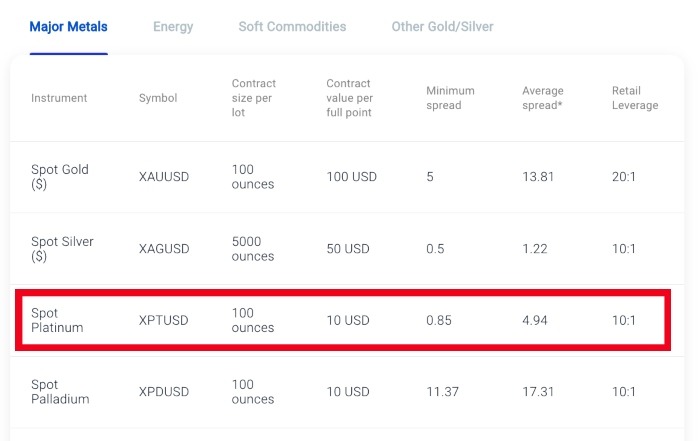
Pepperstone – Platinum Trading Conditions
How To Get Started With A Platinum Broker
- Register with one of the top platinum brokers and log in to the client dashboard
- Identify market opportunities and trends using the trading platform, app and tools
- Open a platinum trading position and apply risk management parameters if required
- Monitor your trade and close when a profit is made or your platinum trading strategy is complete
Trading Hours
Platinum is traded on the New York Mercantile Exchange (NYMEX), the Chicago Board of Trade (eCBOT), and the Tokyo Commodity Exchange (TOCOM).
The platinum market is generally open for trading from 22:00 to 20:59 (GMT).
Bottom Line On Trading Platinum
Platinum trading offers investment opportunities given its scarcity, volatility and the important role it plays in several industries. It may be an attractive asset, particularly during a market downturn, due to its lack of correlation with volatile economic conditions.
Use our list of the best brokers with platinum trading to get started.
FAQ
Is Platinum A Good Investment?
Platinum can be a good investment for those looking to diversify their portfolios. It is a volatile commodity that often sees sharp price fluctuations, which in turn creates opportunities for profits. It can also be a good hedge since it tends to retain its value during market downturns. With that said, online trading is risky and there is no guarantee that you will make profits trading platinum.
How Can I Trade Platinum?
There are several ways to invest in platinum including via contracts for difference (CFDs), exchange-traded funds (ETFs), options, and futures.
Trading hours are typically between 22:00 to 20:59 (GMT), though access to systems including platforms and tools will vary between platinum brokers.
How Do I Choose The Best Platform For Trading Platinum?
The most important comparison factors will depend on your strategy and goals, but FCA authorisation is an important consideration for UK traders. Other features to consider include access to tight spreads and low commissions, reliable platforms and apps, customer support, and demo account provision for beginners.
Is Platinum Trading Easy?
No investment is easy, and successful platinum trading involves frequently monitoring news updates, particularly from those countries involved in the extraction of the resource, such as South Africa and Russia. Any political turbulence or economic changes within these locations can have a large impact on the price of platinum.
What Are The Major Platinum Trading Markets?
Platinum is primarily traded under the symbol XPT on the New York Mercantile Exchange (NYMEX), the Chicago Board of Trade (eCBOT) and the Tokyo Commodity Exchange (TOCOM). The main countries that mine and supply platinum are South Africa and Russia.